Finally, a dumb, campy, lesbian spy parody romantic comedy! The secret genre combination of my heart.
Basically, the D.E.B.S. are an elite international spy organization/college. They fight crime in what appears to be leftover slutty schoolgirl Halloween costumes, carry lots of guns (the bullets never hit anything), and have conversations with holograms on the regular. If you find this picture, of the D.E.B.S. on a stakeout inside a restaurant hilarious, this is the movie for you:
Star D.E.B. Amy falls in love with supervillainness Lucy Diamond, who is also the subject of her women’s studies and crime thesis. She runs off with her and, when the rest of the D.E.B.S. come to rescue her, is disgraced. Lucy escapes capture, and, with the encouragement of her straight best friend/henchman, decides to reform herself and win Amy back with a musical montage:
While it’s a coming out story, everyone gets over Amy’s lesbianism pretty quickly. The issue isn’t that she’s dating a girl, but that she’s dating someone who regularly tries to sink Australia. I hope that someday soon, ridiculous queer genre movies will be widely available, instead of just romantic comedies and tragedies, which I like, but come on, don’t you want to watch a gay action movie? Or a gay monster movie? Or a gay heist movie? (Other than Thelma and Louise?) We need a lesbian Tarantino.
But I’m a Cheerleader stars Natasha Lyonne as Megan, a wholesome, slightly dim, and big-hearted cheerleader.Megan’s friends, parents, and an out-of-drag RuPaul hold an intervention for her lesbianism.Though Megan insists that she’s not a lesbian (“I’m not a pervert.I go to church, I get good grades, I’m a cheerleader!”), they send her to True Directions, a halfway-house for gay kids on the path to heterosexual bliss.Once there, the kids are dressed in baby blue (for boys) and pink (for girls).After Megan has an epiphany about her own homosexuality in a group therapy session, she finds that the other kids are friendly, and just as committed to curing themselves as she is.The only exception is Graham, a surly lesbian played by Clea DuVall, who’s only at True Directions so her rich parents will pay for college.But I’m A Cheerleader is like the world’s funniest women’s studies project, satirizing gender construction and homophobia.The kids are split into groups for lessons on how to properly express their genders, including modeling wedding dresses, changing diapers, and vacuuming for the girls, and chopping wood for the boys.My personal favorite part is a group therapy session where the kids are ordered to find the roots of their homosexuality, which include “My mother got married in pants,” “Too many locker-room showers with the team,” “All-girl boarding school,” and “I was born in France.”
Most of the gay male characters (a teenage wrestler being the one exception) are pretty feminine, but so are most of the girls.Halfway through, there’s an example of how stereotypes are not just limiting, but inaccurate, when Jan, a butch, softball-playing, buzz cut-sporting girl has an epiphany during a group therapy session:
Jan: I’m a heterosexual.
Mike: Not yet, honey, but you’re almost there.And don’t speak out of turn.
Jan: No, no, I’ve never been gay.
(Kids scoff)
Mike:Jan, remember, uh, you molested.Just take a look at yourself.
Jan:I mean, everybody thinks I'm this big dyke because... cause I wear baggy pants, I play softball, and... and I'm not as pretty as other girls but that doesn't make me gay. I mean, I like guys. I can't help it. I just want a big fat wiener up my...
Andre: Amen, sister.
Jan: I quit
(Runs from the room)
Mike:Who the hell is she trying to fool?
This movie is really fun, in a campy, John Waters kind of way.Megan and Graham have good chemistry, and the big dramatic romantic scene involves Megan declaring her love for Graham with a cheer routine.So I give it an A+ as teen movies go.
When I looked up some info about the making of But I’m a Cheerleader (as one does), I read an interview with director Jamie Babbit, where she said that she originally wanted Rosario Dawson to play Megan, but the producers insisted on going with someone who was more “all-American,” which…maybe she and Alice Wu should hang out sometime?I appreciate that sometimes, you have to make sacrifices to get a movie made at all, and Babbit clearly felt bad about it, but when Babbit said she tried to fill the cast with more people of color, I couldn’t help but think that that’s the same kind of the same logic that keeps gay actors busy helping straight girls find love in romantic comedies.
I also highly recommend the documentary on the MPAA, This Picture is Not Yet Rated, in which Babbit appears and explains that she had to cut a masturbation scene by about thirty seconds in order to lose an NC-17 rating.This was the same year that American Pie came out, which taught me that straight boys fucking pies can be seen by 17-year-olds, but you have to be 21 to see a fully-clothed lesbian touch herself, which I actually think would have made a lot of money.
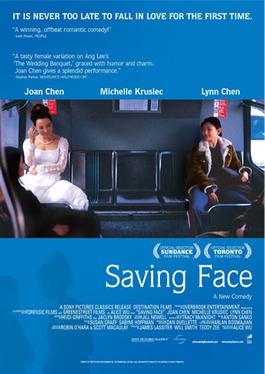
Saving Face is adorable. It should be sold as a 2-for-one deal with He's Just Not That Into You, as an antidote for a truly terrible romantic comedy. Wil is an ambitious surgeon, who makes the pilgrimage to a community dance in Flushings every weekend so that her mother can fix her up with suitable Chinese men. When her mom, a widow, gets pregnant, the family patriarch throws her out of the house until she can produce the father of her baby and regain the family's honor. Because Wil's mom is in deep, deep denial about her daughter's homosexuality--she walked in on Wil and another woman once, and started setting her up with Chinese boys the next day--Wil needs to get her mom married off to a nice, middle-aged Chinese man so that she can persue a relationship with Vivian, a free-spirited Chinese-American ballerina.
Both Ma and Wil live in fear of their parents' disapproval. Wil's grandfather sees Ma's pregnancy as a reflection of his failures as a father, and Wil's mother sees Wil's homosexuality as a reflection on her as a mother. Wil finally forces her mom to acknowledge the truth about her in this scene which is apparently based on writer/director Alice Wu's own life:
Wil: Ma. I love you. And I'm gay. Ma: How can you say those two things at once? How can you tell me you love me, and throw that in my face? I am not a bad mother. My daughter is not gay. Wil: Then maybe I shouldn't be your daughter anymore.
Of course, it's a romantic comedy, so everything works out. Both Wil and Ma learn to shake off familial and community disapproval and follow their hearts. Wil winds up with Vivian, and Ma gets back together with her baby's father, but refuses to marry him because, it turns out, she likes having her own place. Wil's grandfather grudgingly accepts that kids these days are the worst, but looks forward to his grandchild's birth so he can be a good influence in her life. Most importantly, Wil and Ma realize they don't have to live in fear of other people's prejudices.
One of the great things about this movie is that it's a light, sweet, gay romantic comedy that lives pretty much in the real world. When Wil and Vivian dance together at the Chinese dance at the end of the movie, some people walk out in disgust. Wil's triumph isn't that her entire community embraces her for who she really is, but that over the course of the film, she learns that her own happiness is more important. Admirably, Wu doesn't write racism out of the world of the characters. Instead, Ma is put off by Wil's black neighbor but gradually comes to be his friend, giving him face masks and crying over Mandarin soap operas with him.
Apparently, Saving Face is the first movie about Asian American lesbians, and Alice Wu, the writer/director, had to fight to keep it that way. She met with producers who tried to get her to drop the "lesbian angle," or make it about white people, so they could cast Reese Witherspoon, which is shameful, and also stupid. The absence of a straight, white "perspective character" is one of the remarkable parts of the movie. Part of its appeal is that it's about Chinese American lesbians without being anthropological about it. The movie never treats the characters as people who need explaining for the audience to understand them, but instead as individuals.
I feel like I should start this blog off with the truth: I love chick flicks. I could go on for a while about how movies about women and “women’s issues” are just as valid and artistically relevant as movies about men, and how our cultural disdain for women and femininity is translated into disdain for movies about women, and how not taking stories about women seriously represents not taking women seriously, how movies about men are seen as universal while movies about women are othered. But what’s really relevant to this entry in the LGBT Movie Project is my extensive knowledge of romantic comedy clichés. Let me say that not all clichés are bad! The makeover montage, as well as the mid-downpour makeout scene, if deployed properly, can be deeply satisfying. But sometimes romcoms are just ninety predictable minutes of lifeless clichés revolving around blandly attractive straight people. When I watch these movies, I think: Would I find this more compelling if it were about gay people?
So I watched Imagine Me and You and learned: eh, not really.
Imagine Me and You is a 2005 movie about a British woman (Rachel) who falls passionately in love with her lesbian florist (Luce) while walking down the aisle. In 94 minutes, they encounter: precocious children, precocious children in love, milquetoast significant others, old people that have parallel storylines about the nature of love and seizing the day. They have weirdly intense arguments about the nature of love within hours of meeting, only talk to their friends about each other, hang out under fireworks, have humorous misunderstandings about porn, insist that the other wears her coat in the rain, have epiphanies about their true feelings just in time to stop the other from catching her flight, and the film climaxes with one of them publically declaring her love for the other, aided by another character singing a classic pop song. Also, Rachel appears to be a journalist of some sort.
Maybe the most interesting thing about Imagine Me and You is how little hand-wringing there is over Rachel’s sudden apparent bisexuality. The issue isn’t that Rachel is queer, it’s that she fell in love with someone else after marrying her perfectly nice husband. There is one bizarre scene where Luce and a friend see Rachel at the grocery store, and the friend tells Luce it’s totally hopeless: “She’s not just heterosexual, she’s Barbie heterosexual.” Luce looks like this:
The vest and ponytail is how you know she's a Barbie lesbian, not a Barbie heterosexual.
I also like how the movie doesn’t shy away from how awful Rachel is to poor Hector. I mean, his wife runs off with the florist from their wedding in, like, three weeks, based solely on having good chemistry. That sucks. I find it really interesting that the movie doesn’t use Rachel’s somewhat ambiguous sexual orientation as an excuse for cheating on Hector, or paint Rachel as some kind of repressed lesbian who was in denial. She’s just unsure of who she is and what she wants. Imagine Me and You doesn’t define its characters by their genders: Rachel can be more assertive than her husband, who can cook and be great with children, and anyone can have romantic comedy clichés happen to them, which is a step in the right direction.
"Hollywood, that great maker of myths, taught straight people what to think about gays and gay people what to think about themselves."--The Celluloid Closet (1995)
I'm looking at movies featuring lesbian, gay, bisexual, and transgender characters in movies. How are queer characters treated? What messages can we take away from the movies about gender and sexuality?