Finally, a dumb, campy, lesbian spy parody romantic comedy! The secret genre combination of my heart.
Basically, the D.E.B.S. are an elite international spy organization/college. They fight crime in what appears to be leftover slutty schoolgirl Halloween costumes, carry lots of guns (the bullets never hit anything), and have conversations with holograms on the regular. If you find this picture, of the D.E.B.S. on a stakeout inside a restaurant hilarious, this is the movie for you:
Star D.E.B. Amy falls in love with supervillainness Lucy Diamond, who is also the subject of her women’s studies and crime thesis. She runs off with her and, when the rest of the D.E.B.S. come to rescue her, is disgraced. Lucy escapes capture, and, with the encouragement of her straight best friend/henchman, decides to reform herself and win Amy back with a musical montage:
While it’s a coming out story, everyone gets over Amy’s lesbianism pretty quickly. The issue isn’t that she’s dating a girl, but that she’s dating someone who regularly tries to sink Australia. I hope that someday soon, ridiculous queer genre movies will be widely available, instead of just romantic comedies and tragedies, which I like, but come on, don’t you want to watch a gay action movie? Or a gay monster movie? Or a gay heist movie? (Other than Thelma and Louise?) We need a lesbian Tarantino.
If you’ve never seen Some Like it Hot, you should go do that. I’ll wait.
If you still haven’t seen it, Some Like it Hot is a classic cross-dressing comedy. Though it's not technically a gay movie, there's a male/male relationship, and lots of blurring of gender boundaries, with a lack of gay panic that would be refreshing today, let alone in 1959.
Two down on their luck jazz musicians witness the St. Valentine’s Day Massacre and go on the run, but can only find work in an all-girl’s orchestra, so they dress up as Daphne and Josephine and go to Miami. Joe/Josephine (Tony Curtis) sets about trying to seduce Marilyn Monroe, and Jerry/Dapne (Jack Lemmon) finds himself dating an elderly playboy millionaire. As the charade goes on, the Jack Lemmon becomes more absorbed in his Daphne persona, and the beta relationship progresses until gender becomes somewhat beside the point:
Jerry: Have I got things to tell you! Joe: What happened? Jerry: I'm engaged. Joe: Congratulations. Who's the lucky girl? Jerry: I am! Joe: WHAT?! Jerry: Osgood proposed to me! We're planning a June wedding. Joe: What are you talking about? You can't marry Osgood. Jerry: Why, you think he's too old for me? Joe: Jerry, you can't be serious. Jerry: Why not? He keeps marrying girls all the time. Joe: But, you're not a girl! You're a guy, and, why would a guy wanna marry a guy? Jerry: For security! Look, I know there's a problem, Joe. Joe: I'll say there is. Jerry: His mother - we need her approval, but I'm not worried because I don't smoke. Joe: Jerry. There's another problem, like what are you gonna do on your honeymoon? Jerry: We've been discussing that. He wants to go to the Riviera but I'm kinda leaning toward Niagra Falls. Joe: My God. Jerry: I don't expect it to last Joe. I'll tell him when the time's right. Joe: Like when? Jerry: Like right after the ceremony. Then we get a quick annulment, he makes a nice little settlement on me and I keep getting those alimony checks every month. Joe: Jerry listen to me there are laws, conventions. It's just not been done. Jerry: Joe this may be my last chance to marry a millionaire. Joe: Oh, Jerry — Jerry, will you take my advice? Forget about the whole thing, will ya? Just keep telling yourself: you're a boy, you're a boy. Jerry: I'm a boy. Joe: That's the boy. Jerry: I'm a boy. I'm a boy. I wish I were dead. I'm a boy. Boy, oh boy, am I a boy. Now, what am I gonna do about my engagement present? Joe: What engagement present? Jerry: Osgood gave me a bracelet. Joe: [examining it] Hey, these are real diamonds! Jerry: Of course they're real! What do you think? My fiance is a bum?
Director Billy Wilder couldn’t figure out how to end the film, so the actor improvised the final line as a placeholder until someone could write something better:
As if that's not enough, it was rated C for Condemned by the Catholic Decency League, and was banned in Kansas City. So you know they did something right.
“She wanted to be with someone a little more…gay, I guess is the thing.”
Kissing Jessica Stein is about a straight lady who dates a girl, dreads having sex with her, and then dumps her for her ex-boyfriend, but I still pretty much liked it.Helen decides to try dating women, and places an ad in the paper, which Jessica answers on a lark.The part of the movie dealing with Jessica’s anxiety about anyone finding out she’s with Helen, and overcoming her initial repulsion to lesbian sex, stressed me out a lot.I mean, I don’t have the greatest taste in girlfriends, but if you have to actively work to overcome your partner’s disgust with the idea of touching you, you could maybe do just a little bit better.Especially if you look like Helen.
But Jessica’s many neuroses, and her panic about bisexuality, are presented as symptoms of her perfectionism and anxiety about life in general.She’s picky about everything, and decides to go out with Helen because she’s ruled out the entire male gender, and then realizes that the emotional fulfillment she and Helen share isn’t enough to make up for the lack of sex Helen wants. What Jessica wants is a best friend to cuddle with and keep her from being lonely, and Helen wants to be in love.
Helen’s bisexuality is treated with surprising decency: she goes out with Jessica as an experiment, and decides she likes women as well as men, without any of the hand-wringing and self-flagellation Jessica goes through.She decides what she wants and then gets on with it, and at the end of the film, when she and Jessica have broken up, is still dating both men and women.She and her two gay male friends have a series of conversations that seem to be intended to answer lesbian complaints about the plot of the movie, including one where her friend compares having a lesbian relationship on a whim to wearing blackface, to which Helen responds, “Oh, come on, that’s a bad comparison.People are born black,” and her friend says, “Exactly!”The movie seems to be suggesting that sexual orientation is less set than many people are comfortable with, including, I guess, me—maybe because that scenario of your girlfriend dating you on a whim and then leaving you for a boy because it turns out she doesn’t like having sex with you, but really likes the emotional support, is terrifying.Which is the source of a lot of biphobia, and wrong, and not so much a problem with bisexuality as people making mistakes with what they want, but Jessica Stein is kind of a nightmare scenario.
There are a lot of things I really liked about Kissing Jessica Stein.The acting is great, and the dialogue is witty.Jessica’s relationship with her family is lovely. This scene with her mother, right after Helen dumps her for not coming out, has the most emotional depth in the entire film:
Mom:You okay?
Jessica:Uh, I don’t know.No.
Mom:What is it, Jess?
Jessica:It’s just sometimes I tihnk I’m gonna be alone forever…You can jump in any time.
Mom: You’re my love, you know that?My beloved.But sometimes I worry for you.
Jessica:I worry for me too.
Mom:Sweetheart.I will never forget when you were in the fifth grade, and you were so excited when you got the lead in the play.Do you remember that?Really Rosie.
Jessica:Really Rosie.Yeah, I remember.
Mom:And you came home after the first day of rehearsal, and you turned to me, and you said, ‘Mommy, I’m not gonna do it.I quit.’Just like that.I turned to you and I said, ‘Jessie, Jessie my love, why?’And you said, ‘Because my costar isn’t good enough.And if my costar isn’t good enough, then the play won’t be good enough.And I don’t want to be part of any play that isn’t good enough.’And I thought to myself, ‘Oy.This child will suffer.How this child will suffer.’And then they gave it to the meskite with the glasses.
Jessica:Tess Greenblatt.
Mom:Right.
Jessica: God, she was terrible.
Mom:Right. And you would have been great. And you didn’t get to do it.You had to sit there and watch terrible Tess do it with that guy you thought wasn’t good enough, who was actually quite excellent, wasn’t he?And you know?I always thought that you would have been so much happier doing that play, even if it was just okay.Even if it was great, just not the best ever.And maybe, just maybe, it would have been the best ever.You never know.Jessie?
Jessica:Yeah?
Mom:I think she’s a very nice girl.
If all the relationships were this well-crafted, I’d be thrilled with it, but the movie is unfortunately poorly paced an the characters aren’t terribly fleshed out.We cover huge spans of time in minutes, jumping from Helen being embraced by Jessica’s family to them moving in together to Helen complaining that they never have sex to them breaking up because of lack of said sex.It’s a mess, and wedon’t really see why Helen is attracted to Jessica in the first place, or why Jessica and her boyfriend would make a good couple, which, for me, makes it a bit of a failure as a romantic comedy.
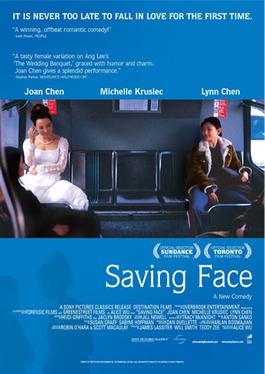
Saving Face is adorable. It should be sold as a 2-for-one deal with He's Just Not That Into You, as an antidote for a truly terrible romantic comedy. Wil is an ambitious surgeon, who makes the pilgrimage to a community dance in Flushings every weekend so that her mother can fix her up with suitable Chinese men. When her mom, a widow, gets pregnant, the family patriarch throws her out of the house until she can produce the father of her baby and regain the family's honor. Because Wil's mom is in deep, deep denial about her daughter's homosexuality--she walked in on Wil and another woman once, and started setting her up with Chinese boys the next day--Wil needs to get her mom married off to a nice, middle-aged Chinese man so that she can persue a relationship with Vivian, a free-spirited Chinese-American ballerina.
Both Ma and Wil live in fear of their parents' disapproval. Wil's grandfather sees Ma's pregnancy as a reflection of his failures as a father, and Wil's mother sees Wil's homosexuality as a reflection on her as a mother. Wil finally forces her mom to acknowledge the truth about her in this scene which is apparently based on writer/director Alice Wu's own life:
Wil: Ma. I love you. And I'm gay. Ma: How can you say those two things at once? How can you tell me you love me, and throw that in my face? I am not a bad mother. My daughter is not gay. Wil: Then maybe I shouldn't be your daughter anymore.
Of course, it's a romantic comedy, so everything works out. Both Wil and Ma learn to shake off familial and community disapproval and follow their hearts. Wil winds up with Vivian, and Ma gets back together with her baby's father, but refuses to marry him because, it turns out, she likes having her own place. Wil's grandfather grudgingly accepts that kids these days are the worst, but looks forward to his grandchild's birth so he can be a good influence in her life. Most importantly, Wil and Ma realize they don't have to live in fear of other people's prejudices.
One of the great things about this movie is that it's a light, sweet, gay romantic comedy that lives pretty much in the real world. When Wil and Vivian dance together at the Chinese dance at the end of the movie, some people walk out in disgust. Wil's triumph isn't that her entire community embraces her for who she really is, but that over the course of the film, she learns that her own happiness is more important. Admirably, Wu doesn't write racism out of the world of the characters. Instead, Ma is put off by Wil's black neighbor but gradually comes to be his friend, giving him face masks and crying over Mandarin soap operas with him.
Apparently, Saving Face is the first movie about Asian American lesbians, and Alice Wu, the writer/director, had to fight to keep it that way. She met with producers who tried to get her to drop the "lesbian angle," or make it about white people, so they could cast Reese Witherspoon, which is shameful, and also stupid. The absence of a straight, white "perspective character" is one of the remarkable parts of the movie. Part of its appeal is that it's about Chinese American lesbians without being anthropological about it. The movie never treats the characters as people who need explaining for the audience to understand them, but instead as individuals.
I feel like I should start this blog off with the truth: I love chick flicks. I could go on for a while about how movies about women and “women’s issues” are just as valid and artistically relevant as movies about men, and how our cultural disdain for women and femininity is translated into disdain for movies about women, and how not taking stories about women seriously represents not taking women seriously, how movies about men are seen as universal while movies about women are othered. But what’s really relevant to this entry in the LGBT Movie Project is my extensive knowledge of romantic comedy clichés. Let me say that not all clichés are bad! The makeover montage, as well as the mid-downpour makeout scene, if deployed properly, can be deeply satisfying. But sometimes romcoms are just ninety predictable minutes of lifeless clichés revolving around blandly attractive straight people. When I watch these movies, I think: Would I find this more compelling if it were about gay people?
So I watched Imagine Me and You and learned: eh, not really.
Imagine Me and You is a 2005 movie about a British woman (Rachel) who falls passionately in love with her lesbian florist (Luce) while walking down the aisle. In 94 minutes, they encounter: precocious children, precocious children in love, milquetoast significant others, old people that have parallel storylines about the nature of love and seizing the day. They have weirdly intense arguments about the nature of love within hours of meeting, only talk to their friends about each other, hang out under fireworks, have humorous misunderstandings about porn, insist that the other wears her coat in the rain, have epiphanies about their true feelings just in time to stop the other from catching her flight, and the film climaxes with one of them publically declaring her love for the other, aided by another character singing a classic pop song. Also, Rachel appears to be a journalist of some sort.
Maybe the most interesting thing about Imagine Me and You is how little hand-wringing there is over Rachel’s sudden apparent bisexuality. The issue isn’t that Rachel is queer, it’s that she fell in love with someone else after marrying her perfectly nice husband. There is one bizarre scene where Luce and a friend see Rachel at the grocery store, and the friend tells Luce it’s totally hopeless: “She’s not just heterosexual, she’s Barbie heterosexual.” Luce looks like this:
The vest and ponytail is how you know she's a Barbie lesbian, not a Barbie heterosexual.
I also like how the movie doesn’t shy away from how awful Rachel is to poor Hector. I mean, his wife runs off with the florist from their wedding in, like, three weeks, based solely on having good chemistry. That sucks. I find it really interesting that the movie doesn’t use Rachel’s somewhat ambiguous sexual orientation as an excuse for cheating on Hector, or paint Rachel as some kind of repressed lesbian who was in denial. She’s just unsure of who she is and what she wants. Imagine Me and You doesn’t define its characters by their genders: Rachel can be more assertive than her husband, who can cook and be great with children, and anyone can have romantic comedy clichés happen to them, which is a step in the right direction.
"Hollywood, that great maker of myths, taught straight people what to think about gays and gay people what to think about themselves."--The Celluloid Closet (1995)
I'm looking at movies featuring lesbian, gay, bisexual, and transgender characters in movies. How are queer characters treated? What messages can we take away from the movies about gender and sexuality?